
AEYN Mentorship Program:
Mentee Project Features
Mentee Projects
Throughout our two-month program, our mentees work on a small project aligned with their professional development goals. With the help of their mentor, mentees scope and create a timeline to accomplish their project. At the end of the program, mentees give a short presentation summarizing their work and results.
See some of our mentees’ projects from previous cohorts below!
Interested in reading more about our program?
Climate Qissa موسمیاتی قصہ
Syeda Hamna Shujat (Cohort 8)
Climate Qissa موسمیاتی قصہ is a bilingual Pakistani climate storytelling platform, founded by Syeda Hamna Shujat, a climate communicator and author published in the World Economic Forum Agenda and Dawn News. Built during the AEYN mentorship program, Climate Qissa exists to amplify Pakistani climate voices that are consistently missing from the global climate conversation. Pakistan is on the frontlines of a climate crisis it barely contributed to, and the communities living that reality are rarely the ones telling it. The platform publishes community stories, articles, and lived climate experiences in both English and Urdu, with no credentials required to submit. Its flagship feature, The Chronicle, weaves individual submissions into a single collective narrative published every two weeks. Climate Qissa is built on one belief: data tells us what is happening. Stories tell us why it matters.
Blindspots in Youth Environmental Efforts (BYEE!)
Raean Cheong (Cohort 8)
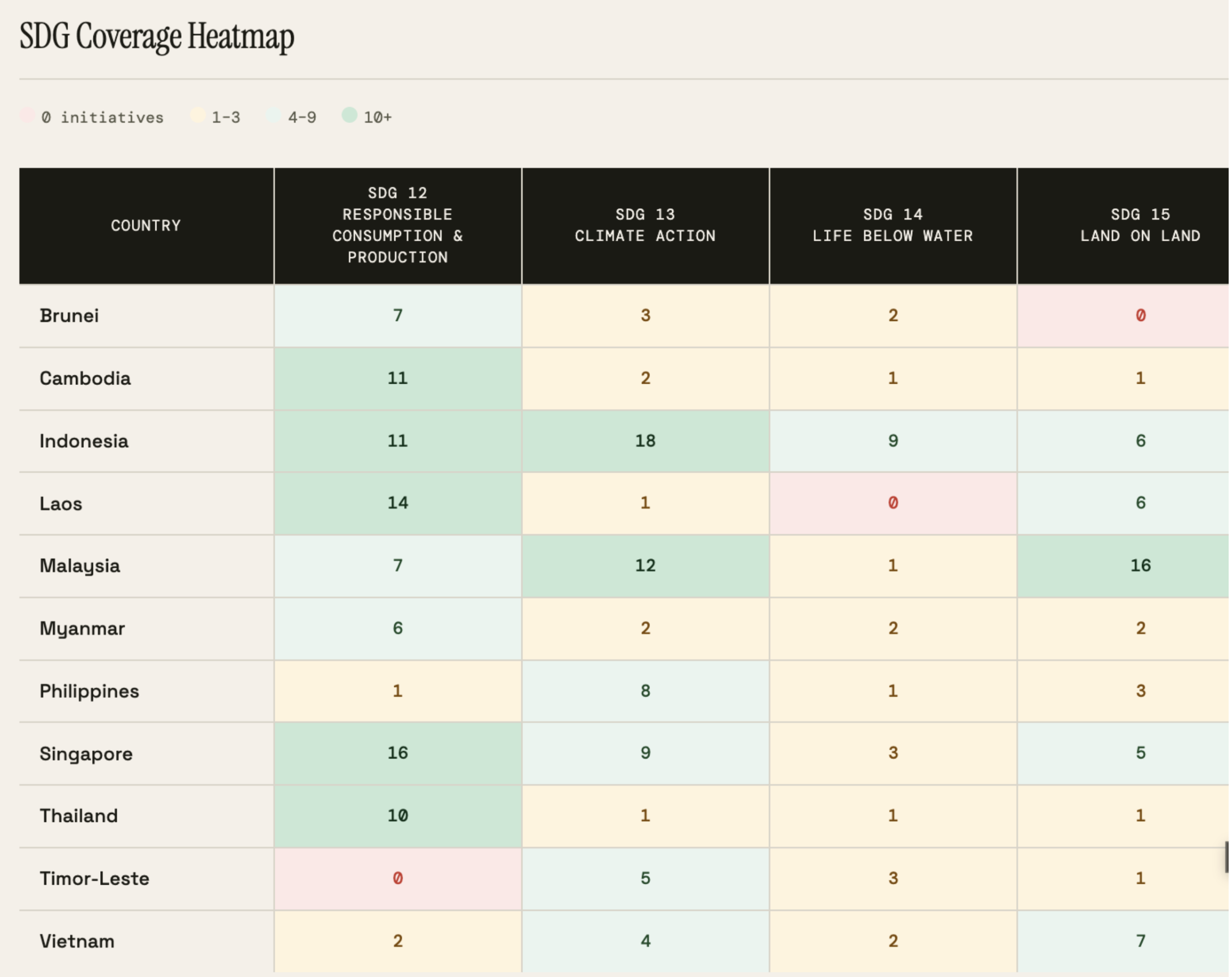
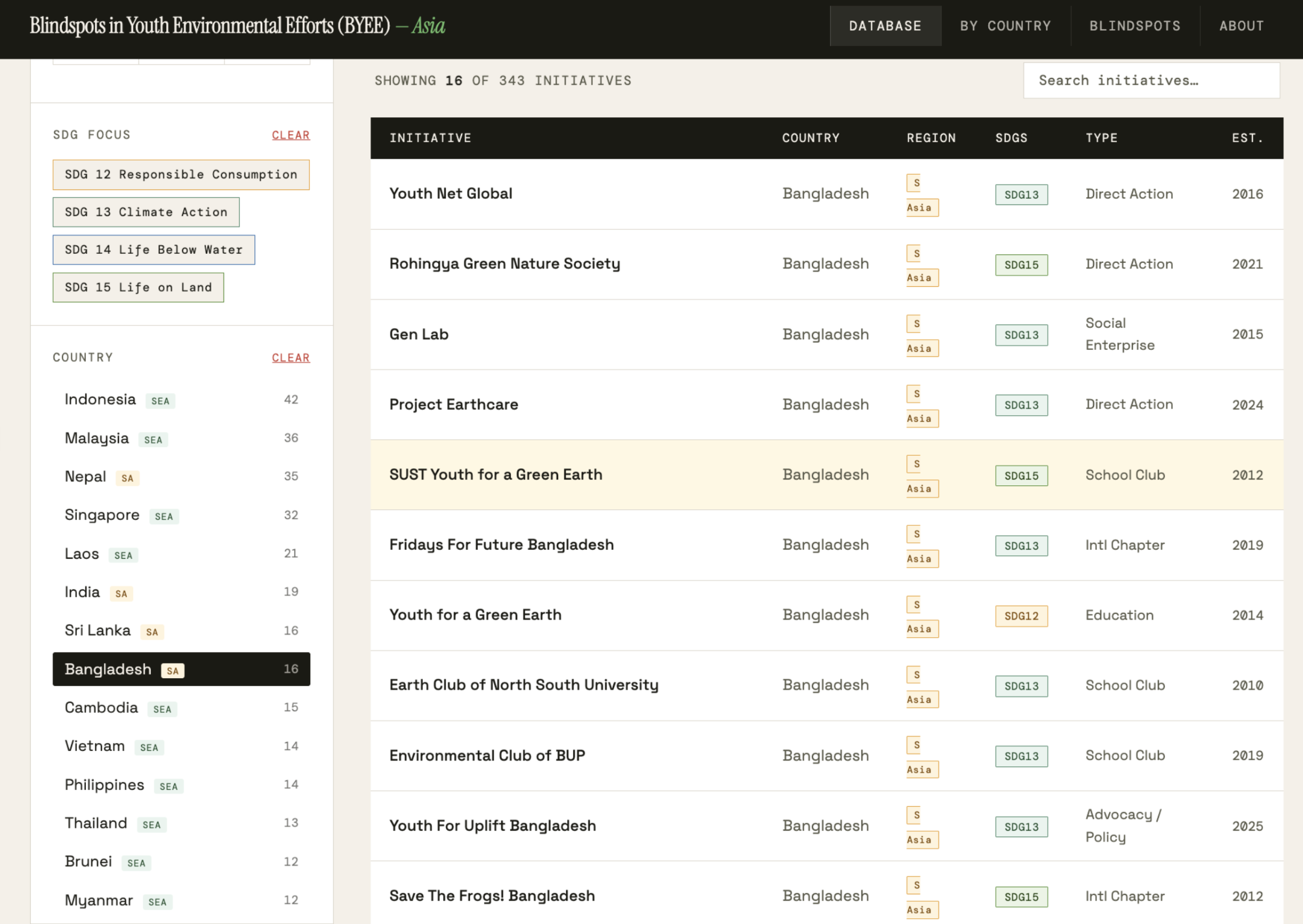
Across Asia, youths are responding to environmental crises through an expanding ecosystem of grassroots initiatives. From founding organisations, running campaigns, and demanding accountability from governments and corporations. Yet the distribution of this activity is far from even. Certain issues, geographies, and communities consistently attract youth-led attention, while others remain largely invisible. These patterns are not random, for they reflect structural inequalities in who has the resources, freedoms, and platforms to organise, and whose environments are treated as worthy of concern. This project, BYEE (Blindspots in Youth Environmental Efforts), is a systematic attempt to map that uneven landscape. Drawing on original research across countries and territories in Asia as defined by the UN Geoscheme, it constructs a public database of youth-led environmental initiatives, categorised by geography, thematic focus, organisational type, and scope.
Enhancing My LinkedIn Profile: Building a Stronger Social Media Presence
Aayotrie Chadhaury (Cohort 8)
“My journey in the AEYN Mentorship Program was a valuable experience that helped me bridge my academic interests and professional development. Together with my mentor, I discussed my research interests in environmental engineering and sustainability, while also receiving personalized guidance on strengthening my LinkedIn profile. Through this process, I learned how to better showcase my experiences, technical skills, and career aspirations, resulting in a more professional and engaging online presence. The mentorship not only improved my visibility and networking opportunities but also increased my confidence in communicating my achievements and goals. Most importantly, it encouraged me to be more intentional in building my professional identity and preparing for future opportunities in research, sustainability, and environmental management.”

Data-Driven Household Energy Assessment for Advancing Energy Conservation Practices and Reducing Energy Bills
Samhitha Thalluru (Cohort 8)
Samhitha worked on a data driven household energy assessment project to advance energy conservation practices and design strategies to reduce the energy bill by 25% for a high rise apartment in Hyderabad. She worked backwards from a real energy bill and a full appliance audit. She identified the energy hotspots and conducted a root-cause analysis that traced high bills back to three clusters: behaviour and awareness gaps, convenience and time constraints, and the home's built-in energy footprint.
Samhitha also conducted interviews to understand consumer behaviours and analysed solutions to build a three-horizon solution roadmap: zero-cost behavioural nudges, medium-term capex on smart AC controllers and heat-pump water heaters, and long-term structural moves like society-wide rooftop solar.
The Perspective of Indigenous Groups in Nepal
Aqila Qanita (Cohort 8)
This project highlights how members of indigenous communities in Nepal — the Tharu and Chepang communities — have in particular faced the brunt of climate change, mainly as a result of historical laws that led them to live on lands more prone to climate-related disasters. Interviews with members of these communities were conducted and data was collected on how climate change has impacted cultural and traditional agricultural practices of these communities, as well as possible solutions for the struggles faced.
“It is important to note we indigenous people, we do not contribute a lot to climate change but we are the most affected.”